Some of the most indefatigable marketing cues in a consumer’s lifetime are predicted by example; as originally realized through visual media by the ham-fisted “brand ambassador,” any organization can appeal to this week’s trending values through conjuring a lately scrutinized, speculative quarry of “social media influencers.” Yes, consumers are meant to classically weigh price against models and options, but the underlying theory is that, in the moment a purchase is made, the consumer is thinking: “People like me,” or “people like us,” who live here, who work and leisure like this, those who espouse my lifestyle buy items like this. It is to say: “I can stand behind the quality and merit of this product or service because I can positively connect another individual’s approval; someone like me is an oracle of mine satisfaction.” There is today a dearth of consumer resources when it comes to selecting a snowblower, so I thought I would prepare this brief informal guide to selecting yours. My exigency here is not to sell a particular brand, but rather to inform the buyer of the underlying mechanical structures offered today. (That said, I’ll bet you’re wondering what I bought.)
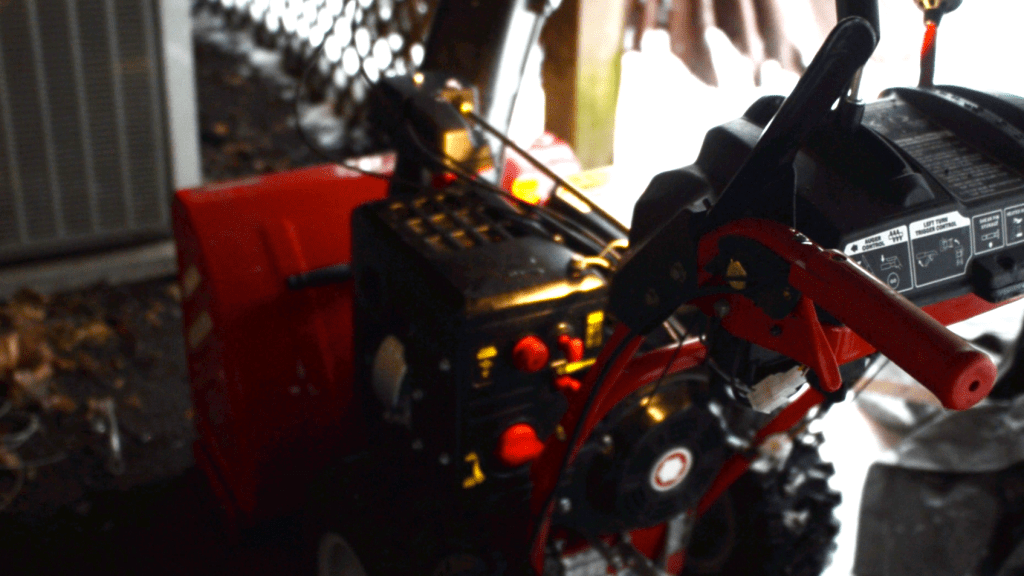
MY SNOWBLOWER
I bought my snowblower because of one of the greatest influencers I’ve ever encountered: My grandfather. The soft-spoken, leathery old man who quit smoking halfway through a pack. (I found the crushed, preserved Pall Malls still within reach decades after, in a coat’s breast pocket.) He told me never to smoke, not even one, because “if you do, you will always want another one, for the rest of your life.” He along with my grandmother lived on almost eight acres of land on a tract at the edge of town, a comfortable expanse of healthy land accessible through a hollow not yet divided and developed when his family arrived around 1910. It was casually agrarian, minus livestock (an adaptation of the family’s original homestead in southern Italy.) The onions sang, the garlic shone when shucked, the vines provided enough grapes to yield a dozen bushels annually, and the trees produced apples, pears, apricots (and my personal favorite, mulberries.) A raspberry bush the size of a Tilt-a-Whirl centrally imparted a bright flavor to the concord grapes. They even had a grand forsythia, a shrub which produced strong bright yellow shoots for tying up the vines. White mulberries are a sort of ambrosia when sitting on a bough in June, with school having let out and the expanse of summer yet to begin. The low breeze barely pushes on one’s face; the air gets slower and thicker, afternoon after afternoon, until it buckles in a thunderstorm.
I digress. The tract provided seemingly endless days of life in the warmer months, but what of the winter? The Mediterranean design froze in place exquisitely, and the fact that this family now encountered such annual difficulties as ice and snow is the genesis of my brand loyalty. As a child, I spent long morning hours with a shovel, followed by afternoons near the fire with my grandma, chicken soup and cartoons. Still working outside as the 4:00 pm twilight rolled in, I heard the drone of my grandfather’s snowblower outside. It was comforting, and especially after the great exercise of manual clearing I would soon fall asleep.
When I got my first desk job, I found myself in a situation a lot of young Americans find themselves in when they keep their head down and stay out of trouble: A little extra money. The winter of ’17 was nigh, and although at the time I rented an apartment on about 1/4 acre of land, I decided it was time to buy a snowblower. After five winters without him, I still recalled the “last job” with my grandfather, in splitting wood from a felled locust tree. The whole family dressed up for January and we all went outside with him and got a convivial, yet largely silent assembly line going. My father mounted sections of wood on the tray as my grandfather operated the switch moving the splitter. My cousins and I collected and stacked the wood as it split and fell to the ground. Having lost an eye years prior and being weeks from death, I was monitoring him and fighting alarm that he would injure himself or someone else, but the job went fine.
I thought of the snowblower, and thought I’d go ahead and buy the 2017 version of it; an old Troy-bilt, faded red, with rusty white wheels and dry-rotted chunky tires wrapped in chains. A big Bakelite crank handle to rotate the chute like butter, and the general dashboard design of a vintage bus. The snowblower I was buying with my heart didn’t have to adhere to any specifics, because I didn’t care or know about them. It just had to be a Troy-bilt and, by extension, it had to be painted a beautiful brand new brick red. Upstate New York manufacturing pride, and all that. (Although I am sure Troy-bilt has been bought and sold eighteen times since its humble beginnings in Troy, New York.) I was not disappointed to find various examples at my local Lowe’s, ranging from $300 to $2300. Within these extremes, countless variables, listed here in descending importance:
- “2 stage” or “3 stage?”
- Engine size?
- Clearing width?
- Tires?
- Options?
TWO STAGE VS. THREE STAGE
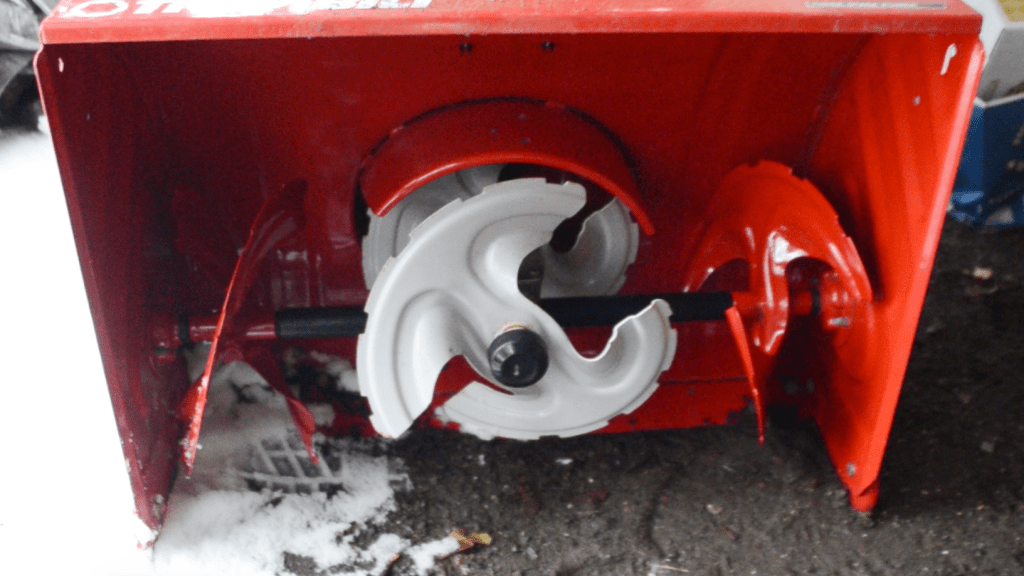
The amount of “stages” a snowblower has refers to how many processing points the snow encounters before it is ejected through the chute. Many industrial snowblowers, like those seen clearing highways or airport runways, feature giant single stage augers mounted under massive, foreboding hoods. This design does not translate well to a driveway or sidewalk because the snow would collect on one side at a lower speed. Torque steer would occur and it would be too difficult to maneuver the snowblower in a straight line.
The design that took snowblowers through the second half of the 20th century is the two stage design; two augers mounted transversely rotating in opposite directions move the snow to a central passage at the rear. The “second stage” is found in another, thicker auger mounted perpendicular at that passage, which breaks the snow down further and pushes it up to the chute. This symmetrical balance allows for more power and torque to be delivered, which results in more snow being cleared.
The two stage design gave snowblower manufacturers a difficult proposition: The crux of the consumer snowblower’s postwar performance relied on an elegant solution straight out of Archimedes’ notebook that left nothing to be desired. Engine size, clearing width, and tire/wheel setups varied as much as any automobiles of the period. Other industry evolution included steering and chute control improvements and shear pins, which break under extreme stress before the engine’s crankshaft is destroyed by something hidden under snow like a baseball bat or a large rock. I am not sure when, but some time in the last ten years the “three stage” design was unveiled; a center auger, larger and faster, acts as an impeller, breaking up wet, heavy snow and ice before the side augers deliver the snow to the third stage (previously second stage.) This technology is featured only on upper-tier examples because of its (perceived) innovation, larger draw on engine power, and more space required to fit three meaningful augers where others fit two.
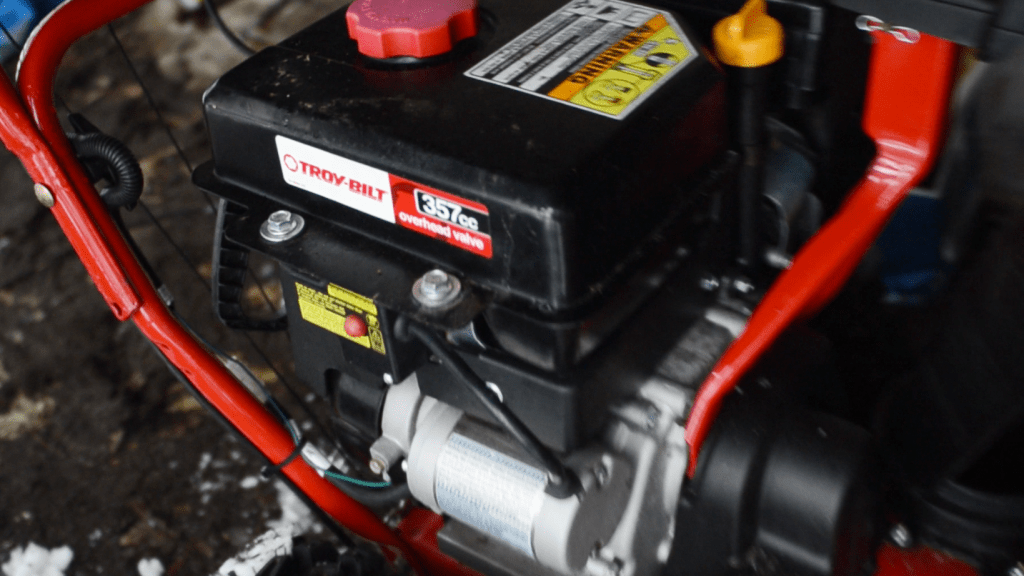
Being that I had “a little extra money” and not a lot, the $2300 model did not appeal to me. It had track-style wheels, like a tank, and was black, disqualifying itself from my vision by default. As all available models were lined up on the sidewalk, I found the one I wanted soon after: A “Vortex 2890” with a $1400 price tag. Yikes! Where it sat on the hotness spectrum:
- “2 stage” or “3 stage?” 3 stage
- Engine size? 357cc (Second to the 420cc)
- Clearing width? 28″ (Top option; 24″ & 26″ available)
- Tires? Oversized
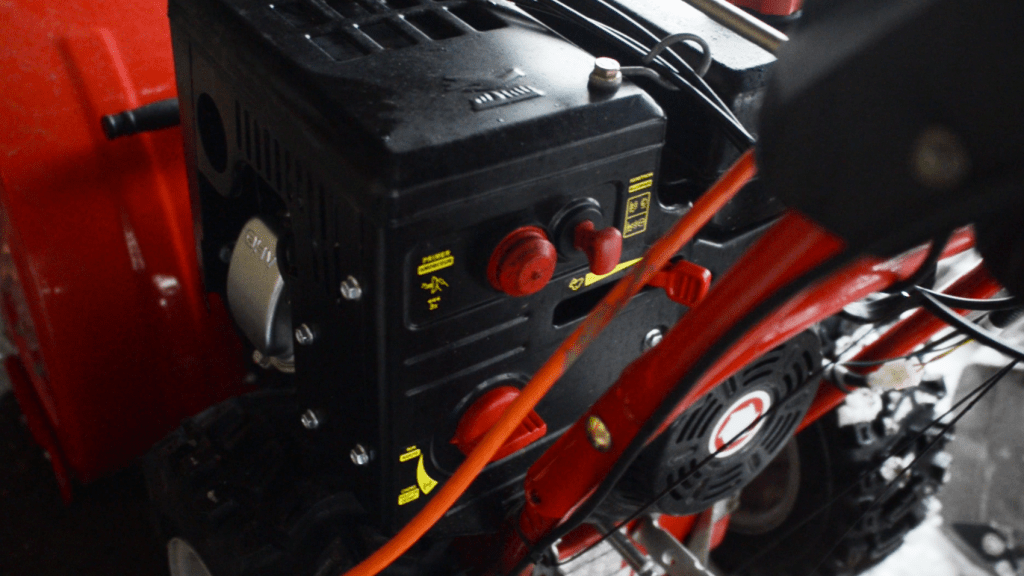
- Options? Headlight, electric start, heated handles
I saw a haggard group of snowblowers of various descriptions a few paces away from the main display, with one in particular catching my eye. Indeed, it was another Vortex 2890, and although lightly used, it looked great! I inquired as to why it was discounted to $1000. The Lowe’s manager explained that it was returned under warranty and the oil pan was replaced. Being auxiliary to the central operation of the unit, I considered that fix to be suitable in the long term; after another fifteen minutes of hemming and hawing, I talked them down to $750. I then opened a credit card which garnered me an additional 5% off. I felt great about my purchase: The modern-day realization of one of my grandfather’s trusty machines, a product with the figurative image of utility, and the literal image of a snowblower, left unchanged over the years. As a product of the Great Depression, I especially imagined his positive assessment of the oil pan’s replacement and approval of my having acquired it at nearly half off.
In practice, the three stage design is a little much. The center impeller smashes with impunity whatever is in front of it, “spitting” the snow everywhere in about a 5′ radius of the augers. This is a very impatient machine that is not unlike a hungry dog on a leash who has just seen a rabbit. Of the six forward gears, I only ever use the first or second speeds when actually engaged with snow; in reverse, both gears are so anemic I often opt to disengage the wheels with individual handle controls, temporarily rendering the snowblower in a neutral drive. It is then easy enough to tilt the snowblower and physically step backwards at a speed exceeding both of those featured on the machine.
Being that I rented lodging on little property, the driveway pad and front sidewalk were where I primarily used the snowblower. After two winters and a dozen storms with the 2890, I have seen great service and have also enjoyed the comforts of push-button electric start and electrically heated handles. Today, I rent a unit with less space still, and am currently without my Troy-bilt. A good friend purchased a new home and I lent it to him indefinitely; A symbiotic arrangement, as he wants access to a upper echelon snowblower as much as I want to see the thing exercised. After I graduate in May and rejoin my professional career, I hope to invest in property like that of my family’s and begin curating the scene for my grandchildren. Every winter, I’ll break out the old snowblower and lull them to sleep as pillows of snow fall silently under creaking locusts.
In shopping for a snowblower, I recommend a two stage solution for the vast majority of applications, especially residential. With a commercial focus on rapid snow clearing speed and uninterrupted service in trafficked areas throughout a snow event, I would still suggest a two stage solution; one with a larger engine, an extra set of tires and a wider (48″+) clearing width. The three stage snowblower works a treat for the type of snow that gets other snowblowers’ wheels spinning in place – Established snow, already rained on and frozen over from a previous event; the type of pack you can stand on. As this snow is rarely encountered, the three stage solution is usually overkill; besides, its propensity towards “spitting” snow everywhere can result in a less-than-perfect presentation when the work is done. A two stage snowblower breathes the job in, Its broad, revolving first stage performing the respiration of snow, like an upside-down Slush Puppie dispenser. A three stage proactively mangles its forward path, rendering snow pre-processed way before it hits the chute.
THE BOTTOM LINE
I ultimately suggest the consumer endeavors to purchase a snow blower that won’t have them shoveling before they can use it. This depends on one’s latitude more than anything else. The other variables all add up to volume, capacity, ease of use – All aspects that can be overcome as a matter of course when the owner tolerates their snowblower. When that achievement is guaranteed, the buyer can feel secure in their decision. Someone out there has what I would call an underpowered, narrow snowblower with small tires and they absolutely love it – Because they live in New Jersey. Today’s luxuries are tomorrow’s minimums – Push button start, for example, has migrated from a “want” to a “need” for me. Those snowblowers with an archaic recoil pull start are no lesser or greater. Almost any snowblower can tackle any storm, if the storm is presented in enough digestible pieces; rather than waiting for an event to end and attempting to clear snow after, a less-equipped model could be run once or twice midway through the event, then once again after it ends. Choosing a snowblower scientifically is half approximation of need, and half willingness to cooperate with what it lacks. I was unable to purchase scientifically because my decision was sentimental, even therapeutic. I wrote this informal buyer’s guide mainly to tell the buying public that the classic two stage design is, in most cases, all you need. Or, is it all you want?
 Leon Ferri