After 12 years of listening to a whole lot of tapes, something broke on my factory car stereo and it started sounding like garbage. I don’t fault Ford for this, because, 12 years. I poked an alcohol-soaked Q-tip on the play head but it didn’t work so I gave up. I got on Ebay and found a few OEM replacements for a hundred bucks or so, but I decided to have a little fun and install an aftermarket deck.
I wanted to do it right, though: The display had to be green, to match the dashboard. CD-only units were out, which alone reduced my choices by about 80%. I did not want a shaft-style radio, so those extra-vintage units were also out. The 1.5 and 2-din DVD / GPS units of 2000-2020 that morphed into today’s “digital media receivers” were out, as nothing with a screen takes a tape. But, what about a CD player? As a child of the 90s I do have a few, yes, quite a few, CDs. I spent a bit of time looking at those units larger than single-din that supported both tape and CDs, but I just couldn’t find one that I liked.
So, I made the difficult decision to lose the CD player and go with a single-din cassette deck. The choices are apparent: Alpine, Nakamichi. Pioneer, Sony, Panasonic, Kenwood, Clarion. Here was my problem: Each of these manufacturers made about 100 distinct car cassette receiver models between ’80 and ’00 and there is next to no product information about any of them available on the Internet. They vary by RMS wattage, capabilities, and superficial face designs and illumination. The search for my tape deck was unlike any other purchase I had attempted online: Constant cross-referencing, model number cutting and pasting, zooming in on scans of product lists (that I couldn’t ultimately read,) even number stuffing, guessing model numbers by inferring cadences between them by seeing other models from that line on Ebay.
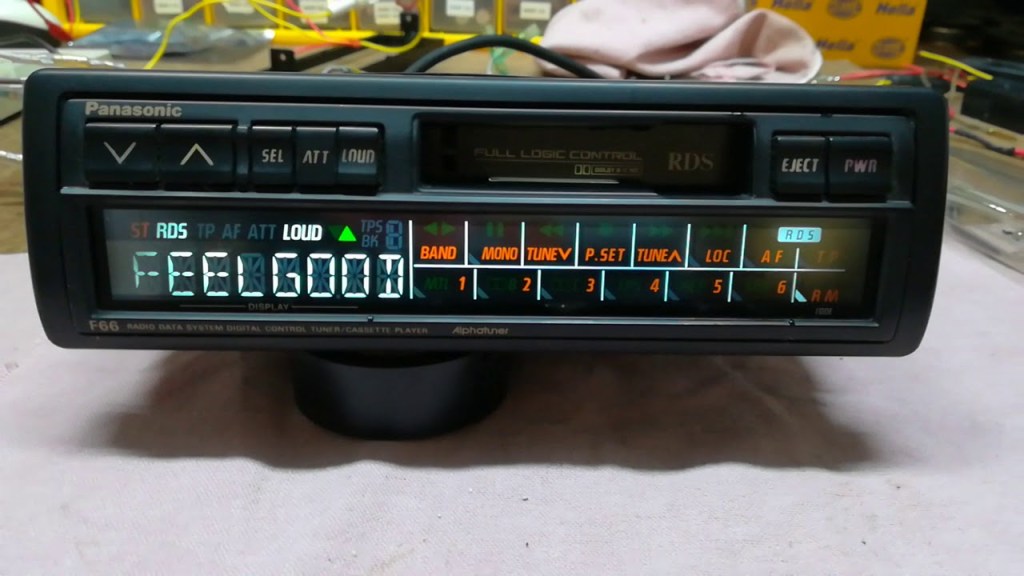
(YT Link) Eventually, I found a gentleman in the Baltics who keeps an Ebay store of exotic rare cassette decks from several manufacturers. What really caught my eye was this Panasonic CQ-FG66EG: A 1989 model with a touchscreen. It was absolutely handsome and I had to have it. Problem was, the ask was $850. I tried to have a dialogue with him, but he proudly proclaimed how he wouldn’t move on the price, no matter what. I don’t fault him for that, but I can’t justify spending $850 on a car cassette deck before shipping.
I wasn’t that heartbroken over missing out on the only one of these for sale anywhere online because this model the seller had was a European model, which as I learned from extensive research through forums and zooming in on units’ factory spec stickers (that I couldn’t ultimately read) are simply useless in North America.
The deal is, in Europe FM goes up by .4 step and AM goes up by 9 kHz. In North America, FM is odd and goes up by .2 like this: 93.1, 93.3, 93.5; AM goes up by 10 kHz, so you have 580, 590, 600, 610. (This was probably done on purpose to reduce inter-hemispherical interference.) In other words, you may be able to successfully install a +12V car receiver from EUR in US and vice versa, but the radio is going to be a redundant feature for imports on both sides. One exception to this is having an analog tuner, which should be able to pick up both. (Japanese FM band works on 76-90MHz, so it is incompatible also.)
If you’re in the market, that’s great to know. As far as I know, this blog post is the Internet’s first complete explanation of this phenomenon. (When shopping set your search filters accordingly.)
Over about a two week period on Ebay, I tried and failed to get the following decks: (If you’re in the market, consider this list:)
Nakamichi TD-45z
YT https://youtu.be/g3aP97wUjf0?si=PavL3a82eJWyJk8i
Kenwood KRC-999
YT https://www.youtube.com/watch?v=s5usDlyQsk8
Alpine 7171
YT https://www.youtube.com/watch?v=4S7QzyfZH2Y
Pioneer KRH-M5002
Ebay https://www.ebay.com/itm/394541361873
Sony XRM-550
YT https://www.youtube.com/watch?v=P9sYQfl6P4w
The best site I found for information on product lines is the Audio Video Component Archive. They only cover Sony, Kenwood, JVC and Pioneer, but these four brands are pretty extensively documented. It is an essential and too-scarce resource. It led me to the KRC-409 which I found on Ebay. Here it is installed in my dashboard.
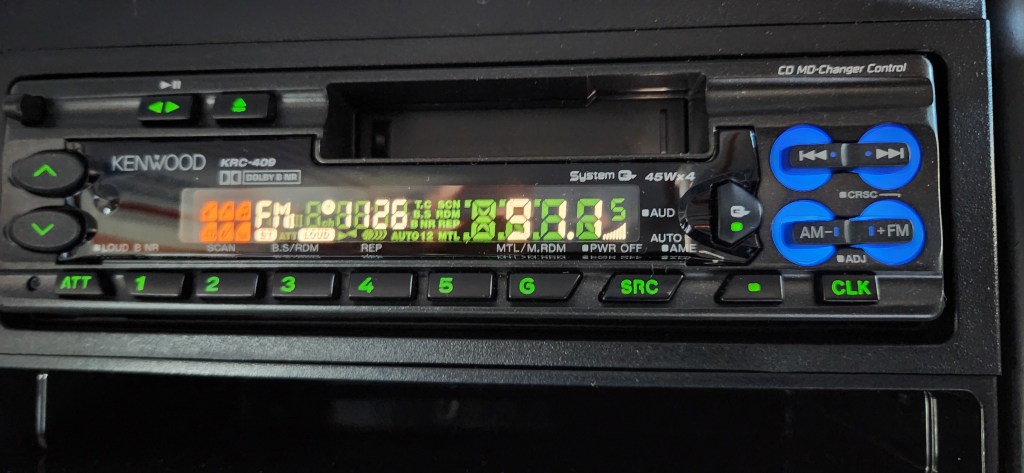
I eventually decided to go with the Kenwood KRC-409 because it had a full logic face (no physical buttons to depress for FF/REW) and was rated at 22 watts per channel (my factory deck was single-digit!) It has a white readout, which I was hesitant on, but pleasant green button illumination. I wasn’t exactly bowled over with it, but, NOS is NOS: All told, the deck cost $104 shipped.
Unfortunately, the tape deck only worked in the right channel (I confirmed correct wiring because the tuner worked in both channels.) So, I had to return it. I went back to doom-scrolling the Audio Video Component Archive and seeing what came up on Ebay.
Suddenly, I saw a Kenwood KRC-X858 available! They wanted $200 but couldn’t test it, so I offered $125 and they bit. Here it is installed in my dashboard:
There is a noted progression in car stereo antitheft technology, where decks from the 80s and early 90s would be completely removable, leaving a hole in the dashboard. The faceplate had an actual fold-out handle, and I suppose one would pull their entire radio out and bring it along to dinner. In the 90s, removable faceplates became the norm. This deck has a unique feature whereby the faceplate folds in and out like James Bond’s license plate, leaving a matte black rectangle on display until the car is turned on again. (I am not sure if this is more or less effective than a blinking red light. Then again, car stereo theft is at an all-time low and I think I’ll take my chances.) As a middle finger to any successful thief, if the unit is removed, there is a security code set by the owner that must be entered when it’s reconnected.
This deck has a lot of audio settings and it’s a little frightening to someone like me who is only used to controlling bass and treble. There’s bass and treble center frequency control, high pass and low pass filters, Q-factor and more. This isn’t Audacity, I’m just trying to drive to work! But some heads would celebrate having this complete control over the audio product. It also has one non-fadable pre-out, which is a wonderful too-rare feature.
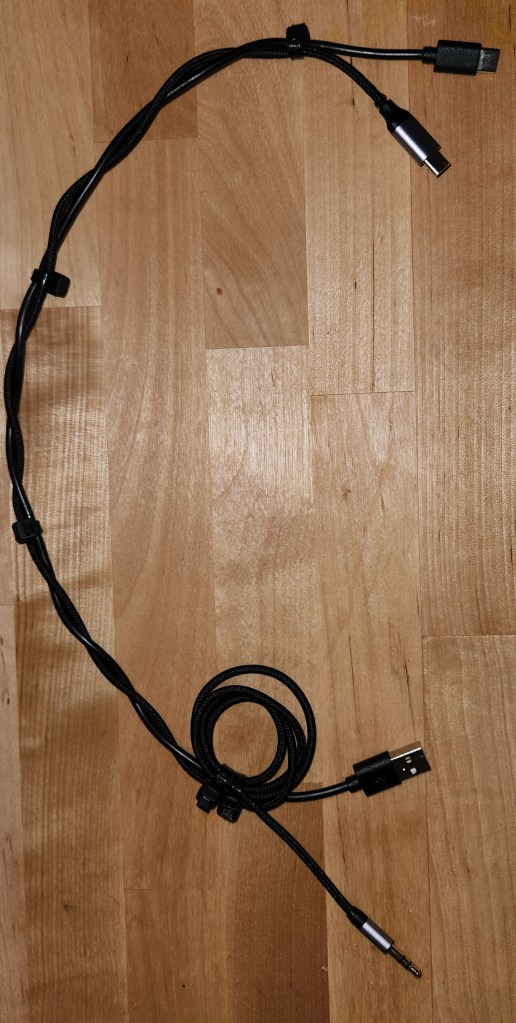
One simple “mod” that brings this deck into 2024 is an antenna-inline FM modulator: When tuned to 87.9 FM, I can flip a switch next to a USB audio port and replace the FM reception with cell phone audio.
Because my new cell phone only has one USB-C port, my workaround is this pair of USB cords simply wound together with zip ties so I can choose to either send audio to the car or charge the cell.
Overall the deck sounds great, I think I am all set until that motorized faceplate inevitably breaks. I think my only point against it is having two volume buttons instead of a flush knob. It is a real step above the KRC-409. (To its credit, the 409 itself with its logic board feels like a big step above models like the KRC-235 or even the KRC-S300 with its wacky faceplate color options.)
One last plug for the Audio Video Component Archive – absolutely crucial product specs for anyone in the market. The north star for car stereo research online!
Thanks for reading, and please leave a comment with any cassette decks that you think can dunk on the ones I mentioned here.
 Leon Ferri